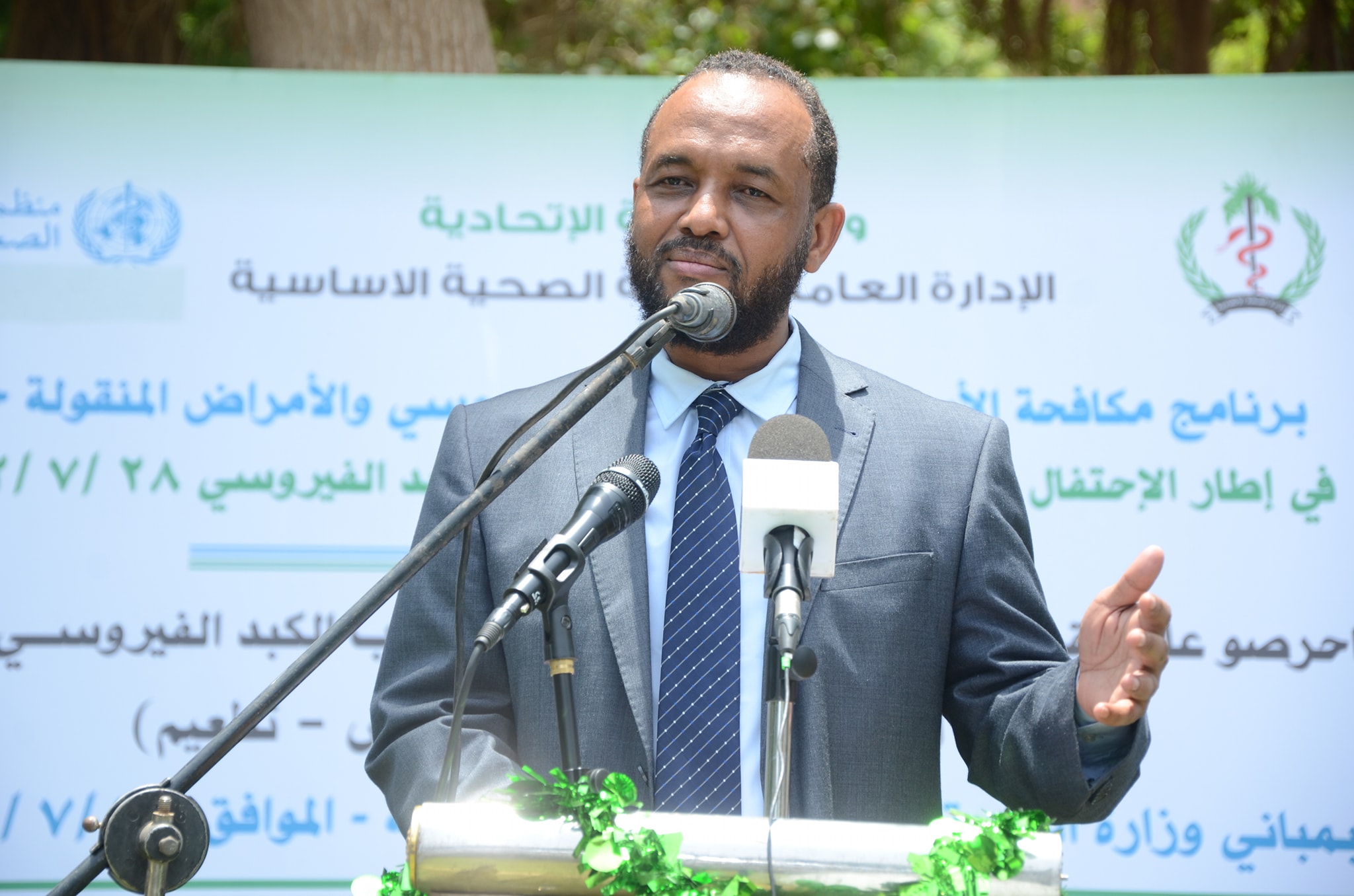
The Acting Minister of Health announces the development of a national strategy to combat the disease
The Federal Ministry of Health celebrated World Hepatitis Day, which falls on the 28th of July every year, with the presence of a representative from the World Health Organization in Khartoum.
During the celebration, the Acting Minister of Health, Dr. Haitham Mohamed Ibrahim, described the situation as extremely serious, noting the high rates of viral hepatitis infection across all segments of society.
The minister affirmed that the ministry has developed a national strategy to combat viral hepatitis, which will be finalized in the coming period, highlighting the need for substantial financial support totaling $170 million by 2030, the year targeted for disease eradication.
He mentioned the expansion of centers, provision of treatment and diagnostics, culminating in liver transplants initiated at Ibn Sina Hospital, considering the successful implementation of liver transplants as a challenging yet successful step.
On another note, the Director of the World Health Organization's office in Sudan, Dr. Namaa Saeed Abid, revealed an increase in hepatitis (C and B) infection rates globally, citing approximately 9.5 million patients receiving treatment.
Dr. Abid emphasized the importance of understanding the magnitude of the problem, commending Sudan's achievement in performing the first liver transplant and considering it a great accomplishment given the exceptional circumstances.
The Director of the National Center for Gastrointestinal and Liver Diseases, Dr. Abdel Monem Taib, acknowledged the high cost of treatment, reaching 20,000 Sudanese pounds monthly, confirming the lack of accurate statistics on the disease's prevalence based on evidence.
Dr. Taib pointed out the existence of 10 examination centers in Khartoum and an equal number in several states, with plans to cover the remaining states next year.
He highlighted that performing the first liver transplant in a government hospital (Ibn Sina) is a credit to the Federal Ministry of Health.
Meanwhile, the Director of the National AIDS, Viral Hepatitis, and Sexually Transmitted Diseases Program at the ministry, Dr. Sara Azhari, stated that viral hepatitis kills more than AIDS and malaria, globally claiming a life every 30 seconds according to statistics.
Dr. Azhari explained that viral hepatitis in Sudan ranks seventh among the 27 highest diseases in terms of rates and is considered an endemic disease.
She pointed out that 90% of patients are unaware of their infection due to the absence of symptoms, necessitating increased awareness for early detection.
Dr. Azhari added that the challenge to eradicate viral hepatitis by 2030 is significant, requiring the ministry to mobilize resources, activate policies, integrate services into primary healthcare centers, and provide vaccination to infected individuals and those most vulnerable to infection.